
 Myrna Whitaker
  Nils Lund
  Anna Broberg
  Lo Elmqvist


EU fast-tracks €34bn rail overhaul
11/11/2025, 10:12
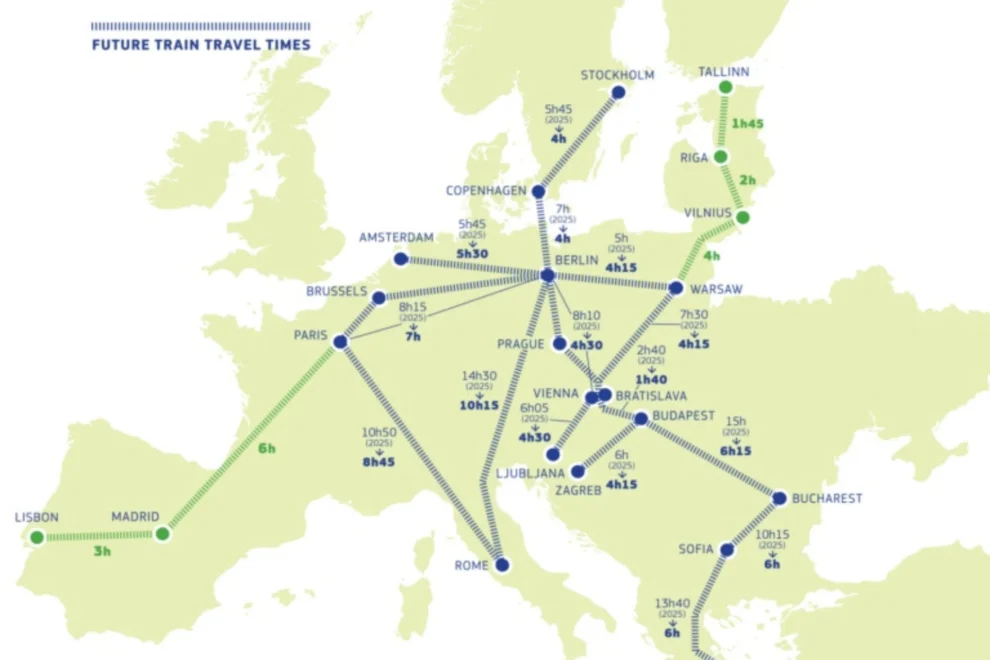
The European Commission has unveiled an ambitious €34bn strategy to halve journey times on major routes and establish high-speed rail as the backbone of continental transport by 2040.
The European Commission has launched a sweeping initiative to halve journey times on key routes and establish high-speed rail as the foundation of a carbon-neutral, interconnected Europe by 2040.
The plan targets dramatic time cuts: Berlin to Copenhagen will drop from seven to four hours by 2030. Sofia and Athens will be linked in six hours by 2035. A new Paris-Lisbon corridor via Madrid will connect Western and Southern Europe.
“High-speed rail is about uniting Europeans, strengthening our economy, and leading the global race for sustainable transport,” said Commissioner Apostolos Tzitzikostas.
The EU has already invested €34.4bn through the Connecting Europe Facility across 804 rail projects. The new strategy will set binding 2027 deadlines to remove cross-border bottlenecks and enable speeds exceeding 250 km/h.
A comprehensive financing strategy will coordinate public and private investment, culminating in a “High-Speed Rail Deal”. A multilateral commitment to complete the Trans-European Transport Network by 2040.
The initiative includes measures to boost competition, improve cross-border ticketing, and create a second-hand rolling stock market. A 2026 research programme will develop next-generation trains capable of seamless cross-border operation.
Progress will be tracked via a new scoreboard, while the European Union Agency for Railways receives expanded powers in 2026 to streamline authorisations.